


ISBN online: 978-80-7331-708-9 | DOI: 10.62804/978-80-7331-708-9
Ester Krumbachová is often discussed as the éminence grise of 1960s Czech cinema. This refers to the fact that her conceptual work with costumes and the overall visual form of the films, as well as significant collaborations on the screenplays, were responsible for the successes of films by directors of the Czechoslovak New Wave, as well as directors of previous generations (such as Zbyněk Brynych, Otakar Vávra, Karel Kachyňa, and Vojtěch Jasný). This is certainly true and applies also to her collaboration on a number of works for television. She also contributed to the development of the New Wave by directing her own farce, Vražda ing. Čerta (Killing the Devil). The film’s genre stylisation has to do particularly with Krumbachová’s long-standing collaboration with Jan Němec and Věra Chytilová on both realised and unrealised projects, such as Tři bratři a zázračný pramen (Three Brothers and the Miraculous Fountain), Čtyřlístek pro štěstí (A Four-Leaf Clover for Good Luck), and Faunovo velmi pozdní odpoledne (The Very Late Afternoon of a Faun). In addition, she joined forces with these filmmakers in writing philosophically themed screenplays (or synopses) about the meaning of life, the attainment of truth, the relationship between man and woman, love, the struggle of good and evil, conformism, the desire for power, the courage to strive for freedom, and other ethical questions, leading to such works as Sedmikrásky (Daisies), Sedmikrásky II, Aby nebyla poslední (So That She Might Not Be the Last), O slavnosti a hostech (The Party and the Guests), Lanval – Báj (Lanval – A Myth), Hra o kouzelné flétně (A Play About the Magic Flute), Jméno kódu Rubín (Code Name: Ruby), and others. These were often related to the subject matter of her literary works. Krumbachová also established long-term collaborations with directors Ivan Balaďa and Jaromil Jireš. She thought through her essential themes during numerous gatherings in her apartment, where she hosted leading exponents of Czech and Slovak culture (and not only on the famous occasion of honey-roasted duck), many of them friends or partners. These included theatre directors and actors Miroslav Macháček, Ivan Vyskočil, and Ladislav Smoček, jazz musician Laco Deczi, art theorist Miroslav Lamač, filmmakers Jan Němec and Michael Havas, and many others. She later assisted members of the younger generation, including costume designer Šárka Hejnová, set designer and artist Lucie Paulů, film directors Petr Václav, Tomáš Hinšt, Bohdan Sláma, and Janez Burger, screenwriters Petr Jarchovský and Ivan Arsenjev, as well as helping the American students of Josef Lustig at the American University in Washington, DC, during their exchanges at Prague’s FAMU. During the 1970s and 1980s, when she was unwelcome in Czech cinematography, she worked abroad in Switzerland and West Germany, and was even present during the early development stages of cinematography in New Zealand. Her cinematic credo is captured quite precisely in a diary entry reflecting on Luis Buñuel’s film The Phantom of Liberty: “Luis Buñuel is the greatest filmmaker in the world. Dream! Truth! Order! Caprice! Instinct! Oh Buñuel, Buñuel, you have saved my soul!”
Screenwriting work for television was less important for Krumbachová, and in the 1980s mostly served to provide an income for the artist, who was otherwise unemployed for political reasons. Her name was only rarely included in the credits. As early as the 1960s, her work was highly innovative, though only part of it was broadcast. Her fairy stories led to the creation of Večerníček, a daily programme for children. The fragments of her Abeceda (Alphabet) represent a unique form. In the second half of the 1980s, she was active in television, working on Michael Havas’s co-produced documentaries Tekutý kámen (Liquid Rock) and První sekunda (The Cosmic Triangle), which were, however, only broadcast after November 1989. She could only really make a living thanks to commissions from the Ostrava studio, starting in 1987, as part of two series: Vonička z domova (Vonička from Home; a vonička is a traditional Moravian-Silesian bow used for weddings) and Malé televizní sezení (Little Television Encounters). She later wrote of these projects: “I had to make a living while there was an artistic embargo on me during the previous regime. But I believe it’s a good thing for me to say that personally, I aim to make a living only on the condition that I not lose my personal honour. […] My state of mind was strongly reminiscent of an unironed shirt, and something had to be done. I don’t even know how, but I came up with a certain terminology: I’m a pianist, so I’ll practise and perfect my fingerings. In this piece of nonsense of which I can make neither head nor tail, I’ll test what I’m capable of. […] This seemingly meaningless work brought me much that is useful. I came up with a number of ideas I’d never have come up with if this were work I respected. I played. I moved various elementary cinematic elements to impossible places – and it worked out, simply because no one was expecting it, so no one even noticed my efforts. That was very good – I could allow myself to do what I needed to TRY OUT. In a way, it was FREE research, FREE study.”
She mostly tested innovative and personal approaches in projects that were, unfortunately, not realised, such as Modrovouska (The Female Bluebeard), where she employed alienation effects and the permeation of various media, or Symposium, where the central crime narrative is enriched with elements of parapsychology in a slightly ironic and humorous hyperbole. Paranormal phenomena are also the subject of the narrative in her series Výstrahy, předtuchy, věštby a sny (Warnings, Premonitions, Prophecies, and Dreams), for which, along with Jiří Mucha’s partner Marta Kadlečíková, Krumbachová created an original structure composed of introductory commentary on the topic followed by the story itself and concluding with a discussion. With Kadlečíková, she wrote a variant of the lottery programme Malé televizní sázení (The Little Televised Betting Show), which alternated narration, in various periods and visual styles, with entries from a commentator and the lottery draw itself. In the early 1990s, when she resumed her collaboration with Chytilová and Němec and returned to live-action film, a collaboration with the Israeli director Peter Freistadt brought her back to the themes that interested her philosophically and existentially, also in regards to her Jewish heritage, which she inherited from her mother. This resulted in a treatment of the life and work of Franz Kafka in a TV film called A svět je den ode dne těsnější (And the World Is More Cramped Every Day…) and the unrealised script fragment Golem. After this, Krumbachová mostly worked in TV as a guest on and participant in various programmes, becoming closer again to the radio, which recorded and broadcast her new goblin fairy tales in 1993.
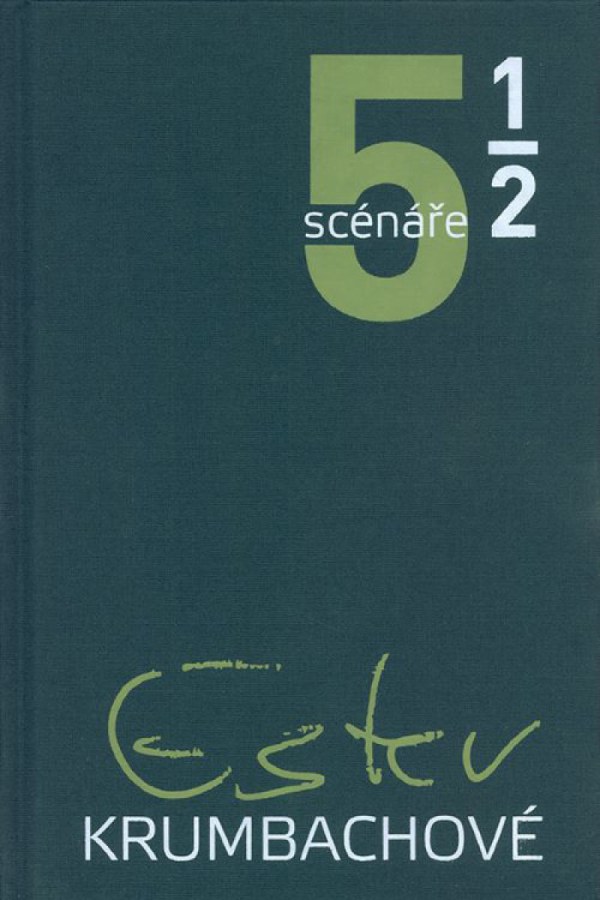
The essays presented in this volume are not concerned with her work as a costume and set designer, nor with her work for theatre and radio. Instead, they represent the first attempt at a broader consideration of her well-known (as well as completely obscure) work as a screenwriter for film and television. They form a guide to what has survived of her work in this area. The requisite archives were recently made available thanks to a collaboration between Are | are-events.org and the Museum of Decorative Arts in Prague. The book includes some of the rediscovered screenplays, Krumbachová’s texts about her work as a screenwriter and costume designer, and a hopefully complete filmography and bibliography.
1. edition, online: 2025, publisher: Akademie múzických umění v Praze (Nakladatelství AMU), Praha
 |
This work is licensed under the CC BY-SA 4.0 Creative Commons Attribution-ShareAlike 4.0 International License